

When an automotive part is heavy, valuable or awkwardly shaped, an ordinary cardboard box is definitely not enough. Components such as brake discs, gearboxes, engine parts, suspension assemblies and metal castings can place considerable pressure on packaging. If the pack is not designed for the job, the part can move, puncture the board or become damaged before it reaches its destination.

So, what packaging is best for heavy automotive parts?
For many heavy automotive parts, the answer is bespoke double or triple wall corrugated packaging, supported by the right internal fittings and, where needed, a palletised base. However, there is no universal pack for every component. The best design is the one engineered around the part’s weight and dimensions, taking into account the fragility of the component and its route through the supply chain.
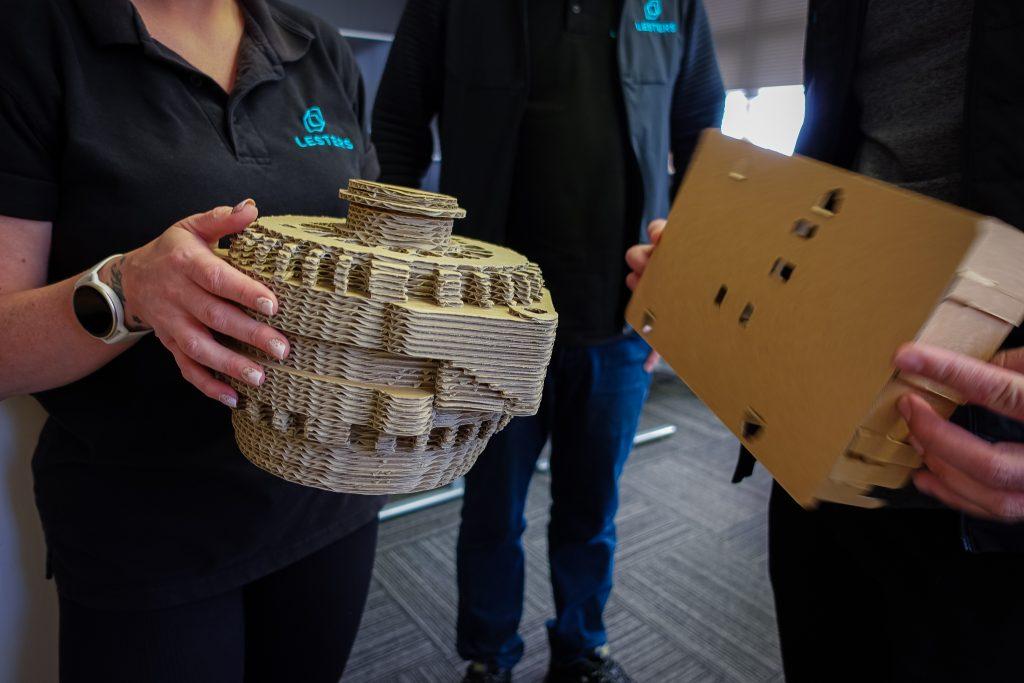
Why do heavy car parts need specialist packaging?
Automotive components create a combination of packaging challenges. They may be extremely dense, have sharp edges or protruding sections, contain delicate machined surfaces, or carry oils and residues. Some also need to travel through several warehouses and handling points before reaching their destination.
Poorly matched packaging can lead to:
- Components moving or colliding in transit
- Boxes bowing, tearing or collapsing under load
- Scratches, dents or damage to finished surfaces
- Moisture, dust or corrosion affecting the part
- Packs becoming unstable when stacked
- More time spent repacking or dealing with rejected deliveries
- Unnecessary material, storage and transport costs
Effective automotive packaging must do more than contain the product. It needs to control movement, distribute weight and remain practical for the people lifting, stacking, storing and unpacking it. See our sustainable solution case study for automotive components.
Is corrugated cardboard strong enough for heavy automotive parts?
Yes – provided the correct board grade and pack design are used.
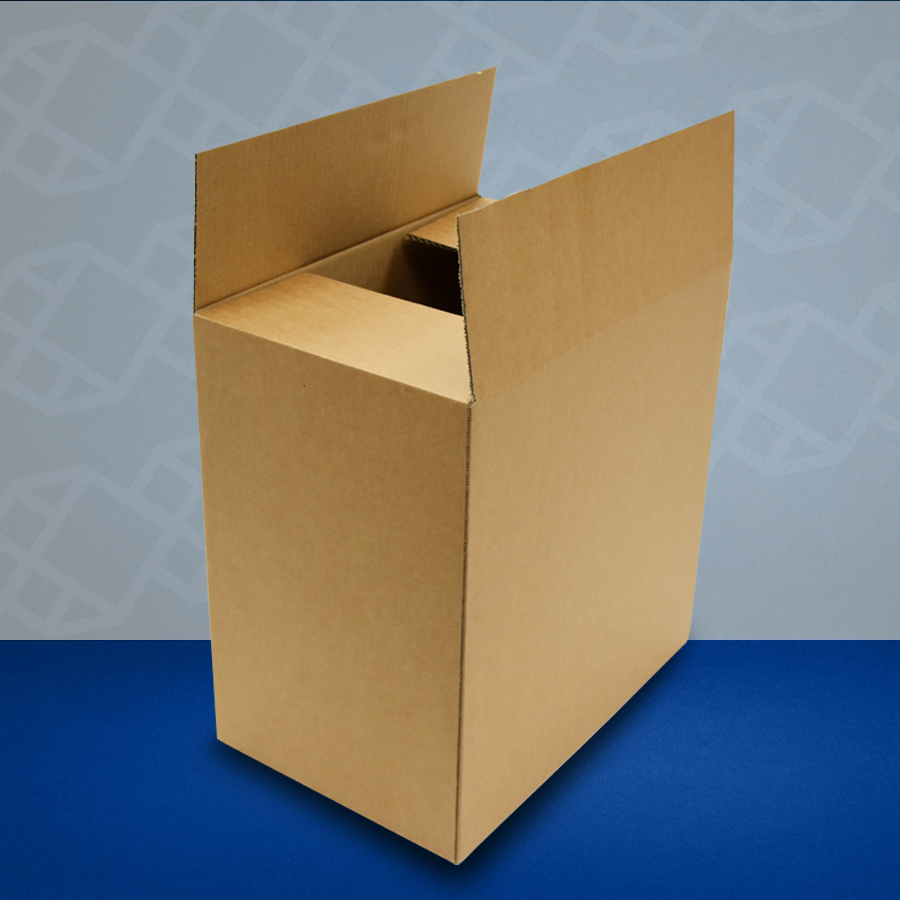
Heavy-duty corrugated packaging is significantly different from a standard single-wall shipping box. Double-wall board contains two fluted layers, while triple-wall board contains three. These additional layers improve compression strength, puncture resistance and rigidity, making the material suitable for many large, heavy and demanding products.
Corrugated packaging also offers several operational advantages:
- It can be designed precisely around the component
- It is lighter than many wooden alternatives
- Boxes can arrive flat-packed to reduce storage requirements
- Board, inserts and dividers can form one coordinated pack
- Handling instructions, part numbers and barcodes can be printed directly onto it
- It is widely recyclable when clean and free from incompatible materials
However, board grade alone does not determine whether a pack will hold up. The direction of the fluting, box style, joint strength, internal support and the way the load is distributed all affect the final result. A stronger board used in a poorly designed box may still fail.
Double-wall or triple-wall packaging: which is best?
The right choice depends on the demands placed on the pack rather than weight alone.
Double-wall corrugated packaging
Double-wall board can be suitable for moderately heavy car components, especially when the pack is compact, the weight is evenly distributed and the journey is controlled. Bespoke inserts can further reinforce the box and prevent the product from moving.
It can offer a useful balance between strength, material use and cost, avoiding the need to over-specify every pack.
Triple-wall corrugated packaging
Triple-wall board is designed for more demanding applications. It may be used for very heavy, bulky or high-value parts, longer supply chains and products that will be stacked or handled repeatedly.
In some cases, a triple-wall box can provide an effective alternative to a wooden case. The correct decision should still be based on the full pack and distribution environment rather than an assumed maximum weight.
When should automotive packaging include a pallet?
A palletised pack may be the better option when a component cannot be handled safely as an individual parcel or when it will be moved by forklift or pallet truck.
Attaching or integrating a heavy-duty corrugated pack with a suitable pallet can:
- Keep the load stable during handling
- Reduce manual lifting
- Help distribute the component’s weight
- Protect the base of the box
- Make warehouse movements quicker and more consistent
- Support efficient vehicle and container loading
The pallet, box and internal fittings should be designed as a complete system. Simply placing a heavy box onto a pallet does not prevent the contents shifting or the load becoming unstable.
Internal fittings matter as much as the outer box
The outside of the pack provides structural protection, but the internal design often determines how well the component survives the journey.
Depending on the part, a bespoke pack might include:
Corrugated fittings and dividers
Die-cut or folded corrugated fittings can hold parts in position, separate multiple components and reinforce vulnerable areas. They are useful when the aim is to create a fibre-based pack with fewer mixed materials.
Foam protection
Foam can cushion delicate areas and protect machined or painted surfaces. It can be shaped around a component, although the amount used should be carefully considered to avoid adding material without improving performance.
Edge and corner protection
Reinforced edges can help prevent sharp or concentrated loads from puncturing the board. They can also improve stacking strength where pressure is transferred through the corners of the pack.
Wrapping and barrier materials
Some metal parts need additional protection from moisture, oils, dust or corrosion. Suitable liners, bags or barrier materials may be incorporated where the product and storage conditions require them.
The aim is not to fill every empty space. It is to support the component at the correct points and prevent damaging movement without adding unnecessary material.
How to choose packaging for an automotive component
Before specifying the board or box style, consider the entire journey of the package.
As a starting point, ask the following questions:
- How heavy is the component? Record the exact weight rather than relying on an estimate.
- Where is the load concentrated? A small, dense part behaves differently from a large component of the same weight.
- Does it have sharp or vulnerable areas? Identify edges, protrusions, connectors and finished surfaces.
- How will it be handled? Consider manual handling, conveyors, pallet trucks, forklifts and automated systems.
- Will packs be stacked? Confirm the stack height, duration and warehouse conditions.
- How far will it travel? A direct local delivery presents different risks from a multi-stage or export journey.
- Is the supply chain one-way or closed-loop? This can affect the case for recyclable or reusable packaging.
- What does the recipient need? Think about part identification, unpacking time, waste separation and production-line access.
These details allow the packaging to be designed around real risks rather than relying on excess material as a safety net.
Bespoke automotive packaging can provide more than protection
The strongest packaging is not automatically the most efficient packaging.
A well-designed bespoke pack can improve several parts of the operation at once by:
- Reducing damage and returns
- Making better use of pallet and vehicle space
- Cutting unnecessary void fill
- Supporting faster packing and unpacking
- Improving stacking and warehouse organisation
- Making part identification clearer
- Reducing the amount of packaging the recipient must manage
That is why packaging should be considered as part of the supply chain, not simply as a box purchased at the end of production.
Heavy-duty packaging shaped around your automotive parts
At Lesters Packaging, we design and manufacture heavy-duty corrugated packaging around the product it needs to protect. Every element can be developed to suit the component and the way it moves.
Our team of designers look at weight, shape, handling, storage and transport requirements before recommending a design. The result is packaging that protects the part without overlooking packing speed, warehouse space, material use or the steps in the supply chain.
Need reliable packaging for heavy, valuable or awkward automotive parts? Speak to Lesters Packaging about a bespoke solution built for the journey ahead.
Packaging sorted. Choose Lesters Packaging.